UGC ad definition (the one-sentence answer)
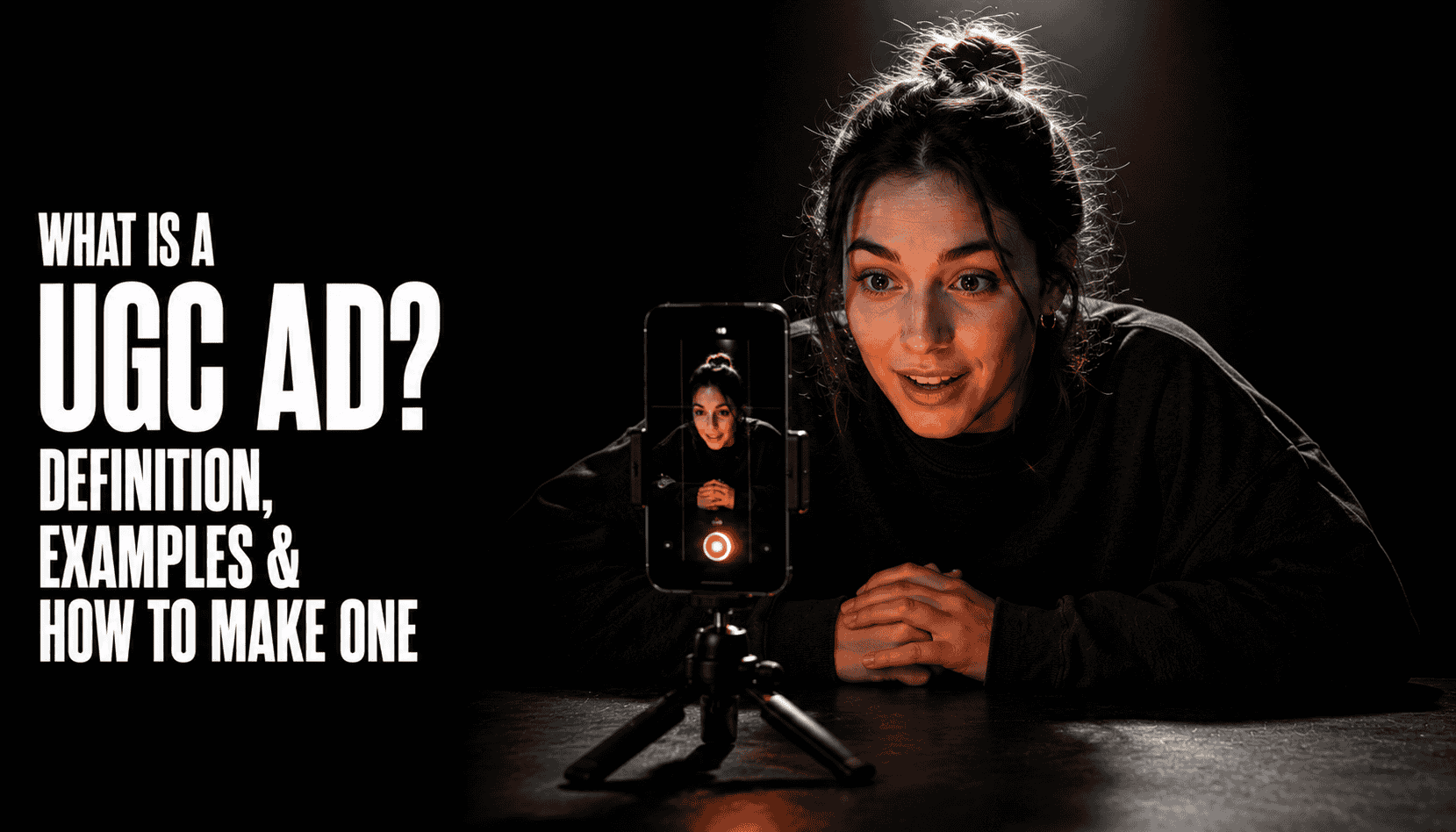
A UGC ad is a video or image advertisement styled to look like organic, customer-made content rather than traditional brand advertising typically a single presenter talking directly to camera about a product, run as paid media on Meta, TikTok, or YouTube Shorts.
"UGC" stands for user-generated content, but by 2026 the term has drifted far from its literal meaning. Most UGC ads today aren't filmed by an actual unpaid customer they're commissioned from freelance creators, or increasingly, generated entirely with AI. What makes an ad "UGC-style" isn't who made it; it's whether it looks and feels like something a real person filmed, rather than something a brand's marketing department produced.
The format exists because native-feeling content consistently out-converts interruption-style commercials in a feed environment. A viewer scrolling TikTok or Reels is primed to skip anything that visually announces itself as an ad UGC-style content earns an extra second or two of attention before that instinct kicks in. Those two seconds are the entire margin of performance in paid social. That mechanic runs across every Meta surface too our complete guide to UGC video ads for Facebook breaks down how it plays out specifically in Feed, Reels, and Stories.
What makes an ad "UGC-style"
Five characteristics show up across almost every high-performing UGC ad, regardless of who or what produced it:
- A single presenter speaking to camera, usually in a selfie-style or handheld frame not a studio setup
- Casual, unscripted-sounding dialogue rather than polished ad copy. The delivery matters more than the production.
- Minimal production value natural lighting, a simple room or real-world setting. The lo-fi look is intentional, not a budget constraint.
- A clear product moment an unboxing, a demo, a before/after, or a direct review. The product is the subject, not the backdrop.
- Native vertical framing (9:16) built for how TikTok, Reels, and Shorts actually display content.
None of this is accidental. Every one of those five traits exists to defeat "ad blindness" the learned habit of scrolling past anything that visually reads as sponsored. The moment a viewer recognises an ad as an ad, their thumb moves. UGC-style content delays that recognition long enough for the hook to land.
UGC ads vs traditional ads vs influencer content
These three get confused constantly because they can look identical on screen. The distinction is in who makes them, for what purpose, and how they're distributed.
| Format | Who produces it | Primary goal | How it's distributed | Production cost |
|---|---|---|---|---|
| Traditional brand ad | Agency or internal creative team | Brand awareness, product launch | Paid placement TV, display, pre-roll | $5K–$500K+ |
| UGC ad | Creator, customer, or AI | Direct response clicks, purchases | Paid social Meta, TikTok, YouTube Shorts | $0.50–$500 |
| Influencer content | Creator with an existing audience | Reach + social proof | Creator's own channel (organic), sometimes whitelisted as ads | $500–$50K+ |
The critical difference between a UGC ad and influencer content is that influencer content is made for the creator's audience, not yours. A UGC ad is made to run as paid media to a cold audience it's a performance asset, not a reach asset. The creator's follower count is irrelevant. What matters is whether the video converts when a stranger sees it for the first time in a scroll.
Traditional brand ads are optimised for brand recognition and emotional recall. UGC ads are optimised for the next 30 seconds of someone's attention and the click at the end. They live in different parts of the funnel and are measured by completely different metrics.
A UGC ad needs to win the first three seconds, not win an award. Studio production solves the wrong problem.
How AI has changed UGC ad production in 2026
Until 2023, producing a UGC ad meant one of three things: wait for a real customer to post something, commission a creator (2–4 weeks, $150–$500 per video), or hire a UGC agency. All three are slow. None of them scale to 40 variants a week.
AI-generated UGC changes the production constraint entirely. An AI UGC video generator produces the same style of ad without a camera, creator, or editor turning a product URL, a text prompt, or a template into a finished video ad using AI avatars or a personal AI Twin, instead of a hired presenter.
The output is nearly indistinguishable from creator-filmed content at scroll speed. The avatar is photoreal. The delivery is casual and conversational. The framing is 9:16. Captions are built in. The only thing that's different from a real creator video is that the entire thing took 15 minutes instead of two weeks, and cost $2 instead of $300.
This shift has made high-volume creative testing accessible to brands that previously couldn't afford to run 50 variants per month. The constraint has moved from "how many ads can we produce" to "how good is our angle selection and hook writing". For a deeper look at how AI and real UGC compare on actual ad performance, see AI UGC vs Real UGC: Which Performs Better?
Structural ad-cloning the dominant scaling tactic
The tactic driving most of the growth in AI UGC adoption is structural ad-cloning instead of writing a new script from a blank page, a brand takes an already-proven ad's pacing, hook placement, and scene structure, and applies it to a new product.
This is functionally the same instinct that made "swipe files" a staple of direct-response copywriting, just automated and applied to video. You don't reinvent the wheel. You take a format that already converts the problem-aware open, the before/after reveal, the "I tried this for 30 days" structure and clone it with a new product, new avatar, new specific claims.
For brands running continuous ad testing, this matters more than raw production value. The bottleneck isn't camera quality. It's how many structurally-sound variants can be produced per week. Structural ad-cloning via an AI UGC video generator is currently the fastest answer to that bottleneck.
For 25 ready-to-clone hook and script structures, see the AI UGC Scripts & Hooks swipe file.
What to look for in an AI UGC video tool
Not every AI UGC generator solves the same problem. Most can produce a talking-head video. The features that actually move ad performance are more specific:
- Structural ad-cloning the ability to replicate a proven ad's format rather than generating from a blank script each time. This is the core workflow for scaling creative testing.
- Consistency tools locking a character, product, or visual style across many generated videos, so a batch of 20 variants still looks cohesive rather than random.
- Avatar and voice range enough demographic variety that a whole ad account's creative doesn't visibly come from the same generator. CTR swings 30–50% on avatar choice alone.
- Multi-language support necessary for any brand running the same campaign across regions. Native voiceover in the viewer's language, not dubbed, makes a material CTR difference.
- Template breadth a wide starting library for initial testing before you have proven formats of your own to clone. Important for brands launching their first AI UGC campaign, whether on TikTok, Meta, or both see our TikTok UGC ads and Facebook UGC video ads guides for platform-specific specs.
For a full breakdown of how the leading platforms compare across these dimensions, see 10 Best AI UGC Generators in 2026.
The 5-step path to your first UGC ad
Whether you're using a real creator or an AI platform, the production workflow is the same five steps. The only variable is how long each step takes.
Use a product URL, a prompt, or a proven template as your starting point rather than writing a script from zero. Define your target customer and the one pain your product solves before touching a tool. That brief - customer + pain + mechanism is the hook. Everything else is production.
Produce several versions with different avatars, hooks, or angles rather than committing to a single cut. The right answer almost never comes from the first render. Generate 3–5 hook variations of the same core script, plus 2–3 avatar options. You're building a test set, not a final creative.
Launch your batch of 3–5 variants into a single ad set with $50–$100 per variant in learn-phase budget. Keep the audience constant across variants. You're testing creative, not audience so isolate the variable. Give the test 48–72 hours before reading results.
Look at hook rate (the percentage of viewers who watch past 3 seconds) and CPA. Hook rate tells you which opening won the scroll. CPA tells you which angle converted. The hook is almost always the highest-leverage variable the avatar and angle contribute, but the opening line is where most tests are won or lost.
Take the format of your top performer its hook angle, its pacing, its proof beat placement and apply it to a new product, angle, or avatar. This is structural ad-cloning in practice. Repeat weekly. The testing loop compounds: each winner teaches you which structures work for your audience, and each clone adds a data point.
For the complete workflow including script templates, visual timing, and launch rules, see How to Create AI UGC Video Ads (Step-by-Step).
Frequently asked questions about UGC ads
What is a UGC ad?
A UGC ad is a video or image advertisement styled to look like organic, customer-made content rather than traditional brand advertising. It typically features a single presenter talking directly to camera about a product, and it's run as paid media on Meta, TikTok, or YouTube Shorts. The defining characteristic isn't who made it it's whether it looks and feels like something a real person filmed.
What is the difference between a UGC ad and a regular ad?
Traditional brand ads are produced in a studio with scripted copy, professional lighting, and obvious production value. UGC ads use a single presenter in a natural setting with casual, conversational delivery designed to blend into a social feed rather than interrupt it. UGC ads consistently outperform traditional ads on CPA in DTC categories because they defeat the learned habit of scrolling past anything that visually reads as sponsored.
Are AI-generated UGC ads as effective as ads filmed by real creators?
Performance is driven more by hook strength and structural clarity than by whether the presenter is a real person or an AI avatar. This is why structural cloning of proven ad formats has become a standard tactic regardless of production method. High-quality AI UGC matches real-creator UGC on CPA for most DTC categories when the script and angle are strong. See AI UGC vs Real UGC for the full data.
How do you make a UGC ad without hiring a creator?
AI UGC platforms generate presenter-style ads directly from a product URL, prompt, or template using AI avatars or a personal AI Twin removing the need for filming, casting, or a production team. The process takes 10–30 minutes: paste the product URL into a platform like UGCad AI, generate hook and script variants, pick an avatar, render with captions, and export to your Meta or TikTok ad account.
How many UGC ad variations should a brand test?
Most performance marketers test 3–5 hook and angle variations per product rather than a single ad, since the opening hook is typically the highest-leverage variable in UGC-style ad performance. Teams running serious creative testing at scale ship 30–100 new variants per week, using AI UGC for the volume layer and real creators for the proven winners that earn hero-creative budgets.
Do UGC ads still work if a brand has no existing creative to clone?
Yes template libraries exist specifically for this case, giving a starting structure before a brand has its own proven formats to replicate. Most AI UGC platforms including UGCad AI include high-performing structures across categories like skincare, supplements, fashion, home, and fitness.
How much does a UGC ad cost?
A real-creator UGC ad typically costs $150–$500 per video, plus 2–4 weeks of coordination. An AI-generated UGC ad costs $0.50–$5 per render on a subscription plan with no coordination overhead and instant turnaround. Most DTC brands at scale use both: AI UGC for high-volume hook testing, real creators for the proven winning angles. See UGC Agency vs AI UGC for the full cost breakdown.
Where do UGC ads perform best?
UGC ads perform best on Meta (Facebook and Instagram Reels), TikTok, and YouTube Shorts feed environments where the native, non-polished aesthetic blends in rather than interrupting. They consistently outperform studio-produced creative on CPA in DTC categories including beauty, supplements, fashion, fitness, and home goods. Platform-specific format tips are covered in the How to Create AI UGC Video Ads guide, and Facebook-specific placement specs are in our UGC video ads for Facebook guide.